
Brighton Seafront Transformation: Council Unveils Plans for Iconic Coastline
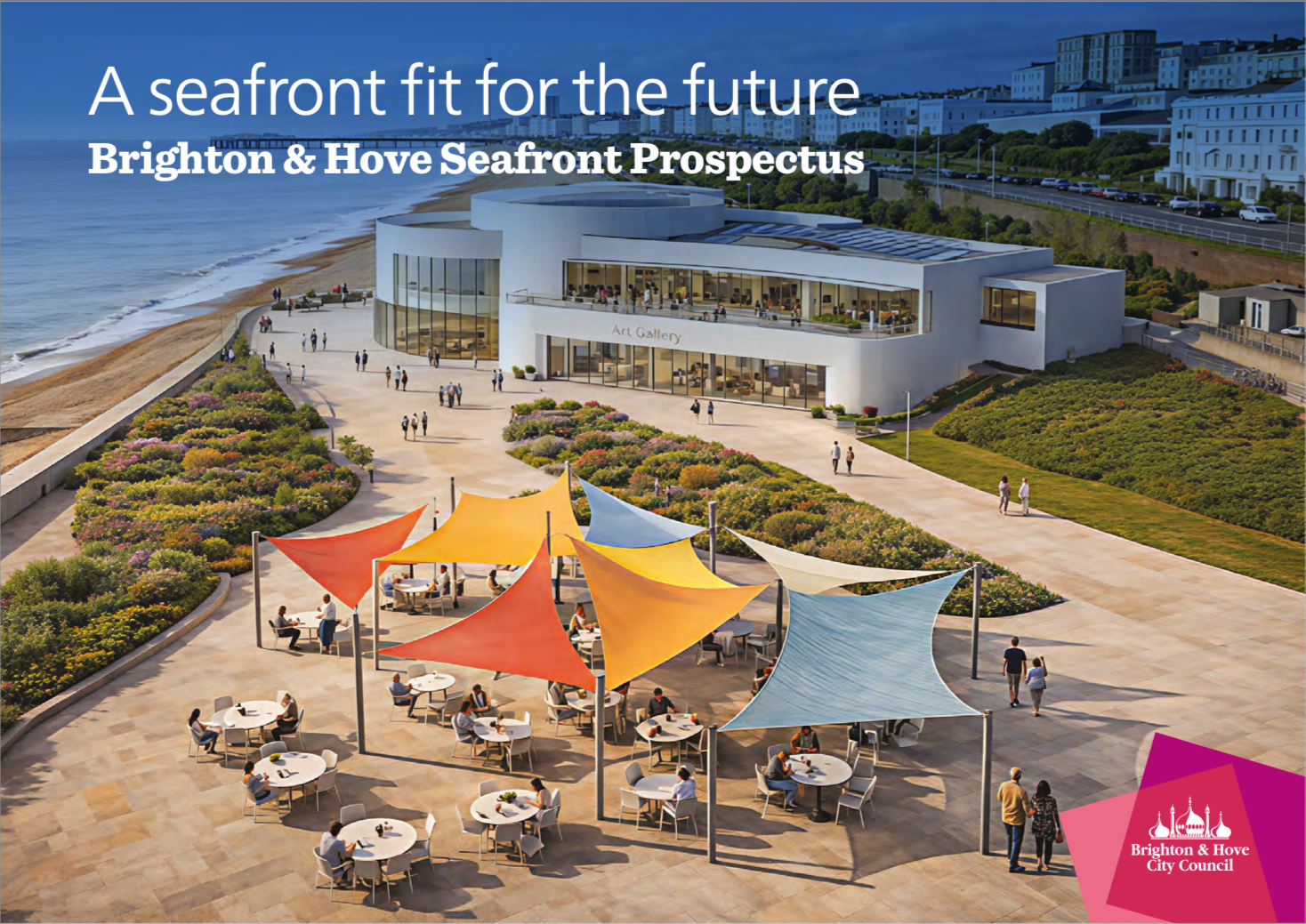
Brighton and Hove City Council published its seafront investment prospectus on 5 June 2026, setting out a long-term vision to transform 13 kilometres of coastline from Hove Lagoon to Saltdean. Image: Brighton and Hove City Council
Brighton and Hove City Council has published its seafront investment prospectus, setting out plans to transform 13 kilometres of coastline into one of the most ambitious regeneration projects the south of England has ever seen
Brighton and Hove City Council published its seafront investment prospectus on 5 June 2026, setting out a long-term vision for one of the UK's most recognisable waterfronts. The 13-kilometre seafront stretching from Hove Lagoon to Saltdean supports everything from tourism and culture to small businesses and everyday leisure for residents. The prospectus sets out a strategic framework to guide regeneration, coordinate activity and give confidence to investors seeking clarity, quality and long-term partnership.
The plans were developed by the Seafront Development Board, chaired by Lord Bassam of Brighton, and build on major schemes already underway across the city including the restoration of Madeira Terrace, the creation of Hove Beach Park and improvements to active travel routes along the seafront.
The council's vision is to create a vibrant, accessible and sustainable seafront that enhances tourism, supports local businesses and celebrates the city's rich heritage. The prospectus makes equally clear that the images it contains are illustrative, designed to inspire potential ideas, and should not be interpreted as current or agreed development proposals.
Foreword
Brighton and Hove's seafront is one of the UK's most recognisable waterfronts. Stretching 13 kilometres, it supports tourism, culture, leisure and a diverse commercial portfolio. The Seafront Development Board was established to oversee the strategic development, commercial future regeneration and sustainable management of Brighton and Hove's iconic seafront, ensuring it is a vibrant, playful, accessible and economically thriving destination for residents, visitors and businesses.
Lord Bassam of Brighton, who chairs the Seafront Development Board, said: "This prospectus sets out that vision. It provides a strategic framework to guide regeneration, coordinate activity and give confidence to investors seeking clarity, quality and long-term partnership. Rather than prescribing fixed outcomes, it establishes priorities, character areas and expectations that help align individual projects into a coherent, investable proposition."
Council leader Bella Sankey said: "As a proud Brightonian I know that our seafront is one of Brighton and Hove's most cherished assets. It defined my childhood. Now this prospectus sets out how we will steward the seafront for the long term. It brings together existing work and future ambition into a single, place-led vision that balances growth with care for our heritage, environment and communities. It shows how investment can raise quality, improve access, support local businesses and ensure the seafront works for residents as well as visitors, all year round."
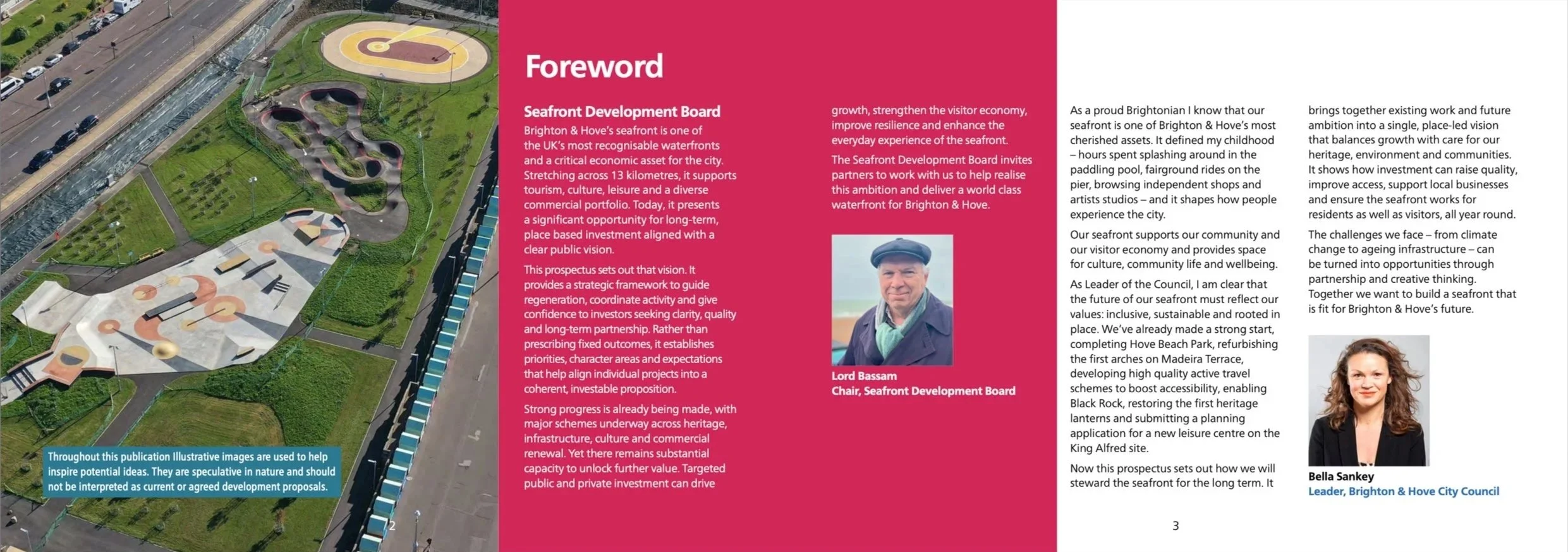
Lord Bassam of Brighton chairs the Seafront Development Board alongside council leader Bella Sankey, who described the seafront as one of Brighton and Hove's most cherished assets. Image: Brighton and Hove City Council
A seafront fit for the future
Brighton and Hove's vision is to create a vibrant, accessible and sustainable seafront that enhances tourism, supports local businesses and celebrates the city's rich heritage. As one of the UK's most iconic waterfronts, the seafront is celebrated for its distinctive blend of heritage, creativity, eclectic seaside character and contemporary leisure experiences. Stretching 13 kilometres from Saltdean to Portslade, it acts as a gateway to the city and a vital asset for the wider Sussex region.
The seafront should reflect the city's individuality and culture, a place that can be experienced as an international destination, a familiar community space or a refuge to simply be yourself. The aim is to make the best use of the sea and shoreline, balancing long-term environmental protection with year-round opportunities for arts, sport, hospitality and events.
Regeneration will be delivered through sustainable development that brings together commerce, culture, recreation and nature, from restoring landmark heritage assets such as the seafront arches to investing in Brighton and Hove's urban biosphere, The Living Coast. Supported by sustainable transport infrastructure, the seafront will be easy to access for all and serve as a dynamic link across Sussex. Shaped through collaboration with residents, businesses and partners, this approach will unlock the full potential of the coastline and secure a seafront to be proud of, now and for future generations.
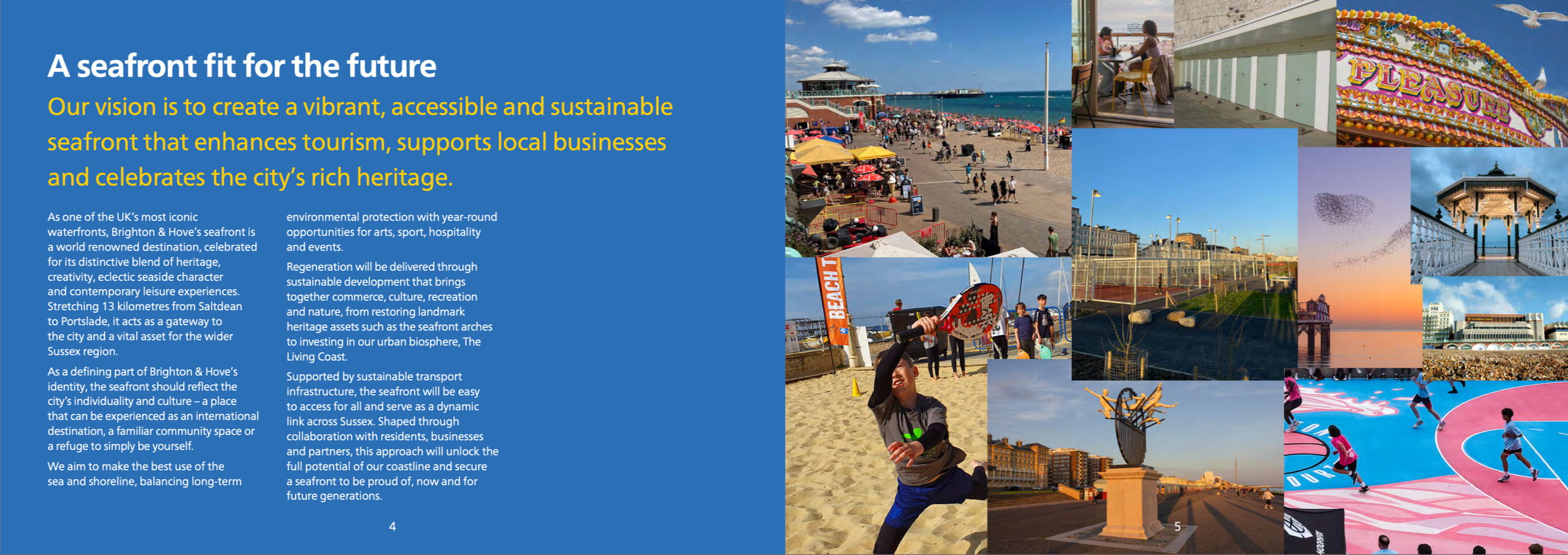
The vision for Brighton and Hove's seafront is to create a vibrant, accessible and sustainable waterfront that enhances tourism, supports local businesses and celebrates the city's rich heritage. Image: Brighton and Hove City Council
A seafront that's uniquely ours
As well as being a major visitor destination, the seafront is a vital space for creativity, culture, play, learning and social connection. Brighton and Hove has a nationally significant concentration of talent in arts, culture and the creative industries, which are central to the city's economy, identity and long-term resilience. Ongoing investment is essential to sustain this success.
Culture and creativity drive a year-round programme of activity, including more than 60 festivals that generate footfall, visitor spend and local jobs. The city has the highest concentration of people working in arts, culture and heritage outside London, with over 10,000 creative businesses supported by a highly skilled workforce and freelancers. This strong foundation means Brighton and Hove can successfully support new cultural infrastructure and has the established visitor and resident audiences to make them a success.
Working across 100 miles of coastline, including all of Brighton and Hove's seafront, Sussex Bay brings together communities, scientists and artists to deepen understanding of, and connection to, the marine environment. Cultural and learning uses on the seafront can play a key role in this work, creating visible places where creativity, education and environmental stewardship come together, reinforcing the city's leadership in nature-positive, place-based investment. The seafront will remain a place where today's children can grow, thrive and build lasting connections to the city they call home or love to visit.
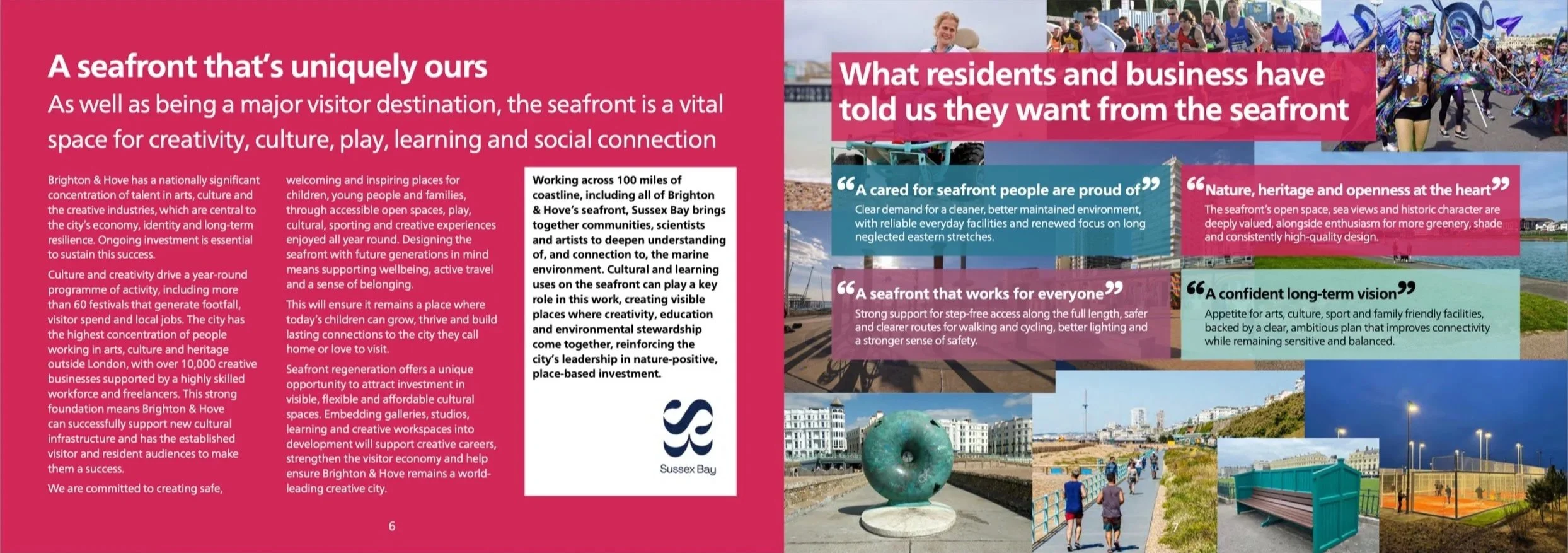
Brighton and Hove has the highest concentration of people working in arts, culture and heritage outside London, with over 10,000 creative businesses supported by a highly skilled workforce. Image: Brighton and Hove City Council
A seafront to be proud of: a regeneration strategy
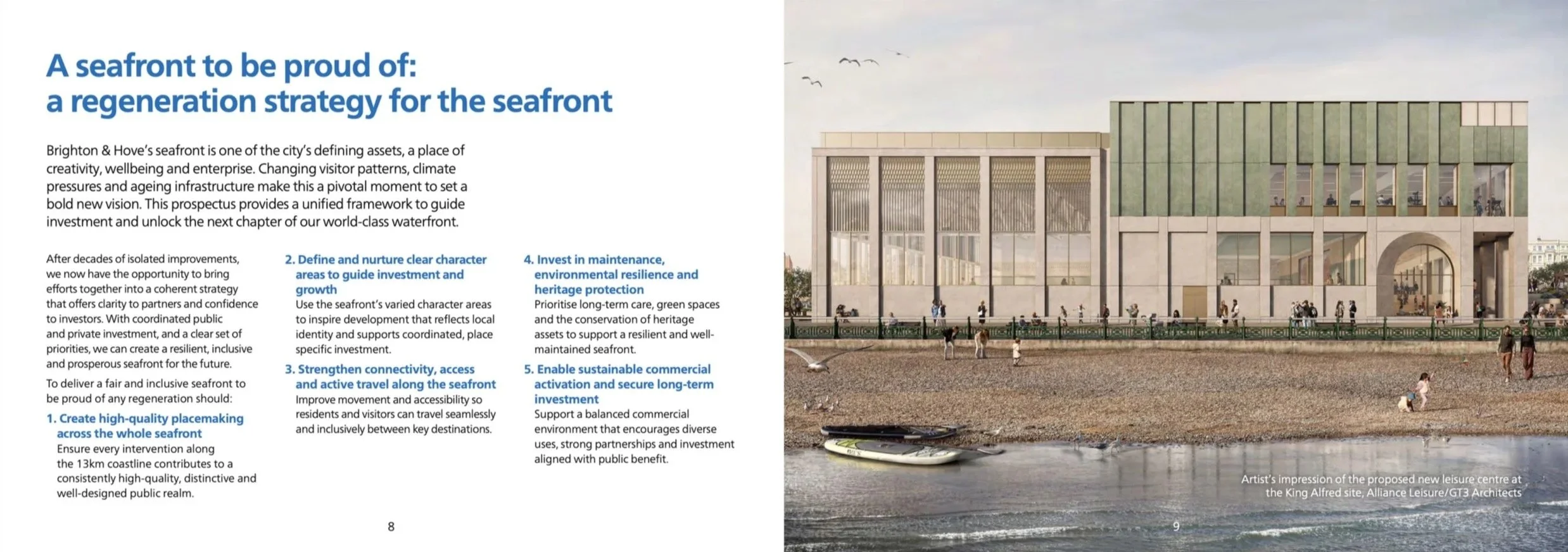
Brighton and Hove's seafront is one of the city's defining assets, a place of creativity, wellbeing and enterprise. Changing visitor patterns, climate pressures and ageing infrastructure make this a pivotal moment to set a bold new vision. The prospectus provides a unified framework to guide investment and unlock the next chapter of this world-class waterfront.
The regeneration strategy is built around five priorities. The first is to create high-quality placemaking across the whole seafront, ensuring every intervention along the 13-kilometre coastline contributes to a consistently high-quality, distinctive and well-designed public realm. The second is to define and nurture clear character areas to guide investment and growth, using the seafront's varied character areas to inspire development that reflects local identity and supports coordinated, place-specific investment.
The third priority is to strengthen connectivity, access and active travel along the seafront, improving movement and accessibility so residents and visitors can travel seamlessly and inclusively between key destinations. The fourth is to invest in maintenance, environmental resilience and heritage protection, prioritising long-term care, green spaces and the conservation of heritage assets to support a resilient and well-maintained seafront. The fifth is to enable sustainable commercial activation and secure long-term investment, supporting a balanced commercial environment that encourages diverse uses, strong partnerships and investment aligned with public benefit.
After decades of isolated improvements, the prospectus brings efforts together into a coherent strategy that offers clarity to partners and confidence to investors. With coordinated public and private investment and a clear set of priorities, the council believes a resilient, inclusive and prosperous seafront for the future is achievable.
Plans to connect the full 13 kilometre seafront corridor with improved active travel routes, widened pavements and a continuous cycle lane from Hove to Brighton Marina. Image: Brighton and Hove City Council
Seafront investment plan
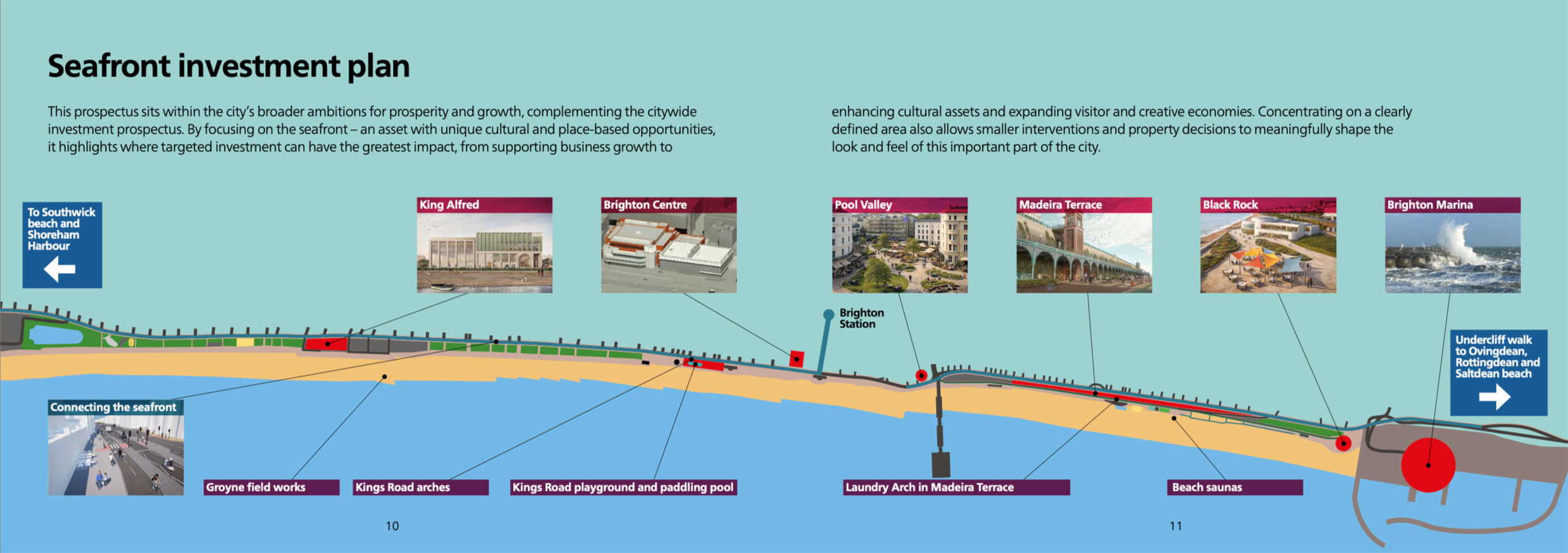
The prospectus sits within the city's broader ambitions for prosperity and growth, complementing the citywide investment prospectus. By focusing on the seafront as an asset with unique cultural and place-based opportunities, it highlights where targeted investment can have the greatest impact, from supporting business growth to enhancing cultural assets and expanding visitor and creative economies.
The key opportunity sites identified in the investment plan are King Alfred in Hove, the Brighton Centre, Pool Valley, Madeira Terrace, Black Rock and Brighton Marina. Each site is at a different stage of development and each presents a distinct opportunity for investors, arts organisations, developers and the public sector to work together.
Concentrating on a clearly defined area also allows smaller interventions and property decisions to meaningfully shape the look and feel of this important part of the city. The prospectus makes clear that the illustrative images used throughout are speculative in nature and should not be interpreted as current or agreed development proposals.
Brighton and Hove City Council's seafront regeneration strategy sets out five priorities to guide investment and unlock the next chapter of this world-class waterfront. Image: Brighton and Hove City Council
Black Rock
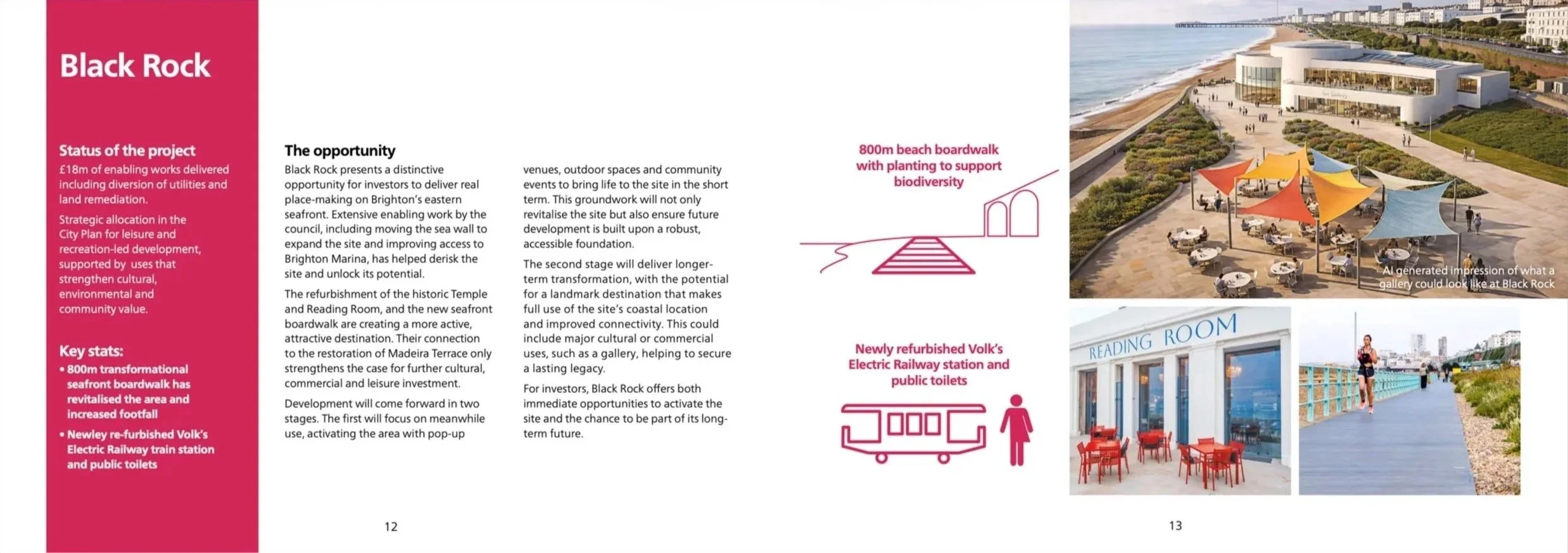
Black Rock is the most significant single opportunity site in the prospectus. The site on Brighton's eastern seafront has been empty for decades. More than £18 million of enabling works have already been delivered, including diversion of utilities, land remediation and the strengthening of the sea wall. The site has a strategic allocation in the City Plan for leisure and recreation-led development.
Development will come forward in two stages. The first stage will focus on pop-up venues, outdoor spaces and community events to bring life to the site in the short term. This groundwork will not only revitalise the site but also ensure future development is built upon a robust, accessible foundation. An 800-metre transformational beach boardwalk has already been completed, revitalising the area and increasing footfall. Volk's Electric Railway station has been newly refurbished alongside new public toilets.
The second stage will deliver longer-term transformation, with the potential for a landmark destination that makes full use of the site's coastal location and improved connectivity. This could include major cultural or commercial uses such as a gallery, helping to secure a lasting legacy. The council is understood to be in discussions with a major London gallery about the Black Rock site. For investors, Black Rock offers both immediate opportunities to activate the site and the chance to be part of its long-term future.
The seafront investment plan showing key opportunity sites from King Alfred in Hove to Brighton Marina in the east, published by Brighton and Hove City Council in June 2026. Image: Brighton and Hove City Council
Madeira Terrace
Madeira Terrace is on the cusp of a historic transformation. The 865-metre Grade II listed Victorian terrace, one of the longest cast iron structures in the world, stretches along Brighton's eastern seafront. The first phase of restoration of 28 of the arches is nearly complete by end of 2026, with funding including crowdfunding and a Historic England grant. More than £17 million has been invested in the first phase. The gross development value of the Madeira Terrace project is more than £50 million.
This iconic landmark, with its elegant arches and sweeping sea views, is ready to reclaim its place as the beating heart of Brighton's eclectic seafront. The opportunity now is to ignite a new era that introduces bold new experiences and brings the terrace to life as a destination in new ways. The terrace includes a Victorian Shelter Hall that currently houses the Concorde 2 music venue.
Complementary uses above or behind the terrace could sit sensitively with the heritage structure and support a viable delivery model. Pop-ups and events can build footfall and confidence ahead of longer-term development. For investors, this is a chance to be part of a legacy and create a landmark that shapes the future of Brighton's seafront for generations to come.
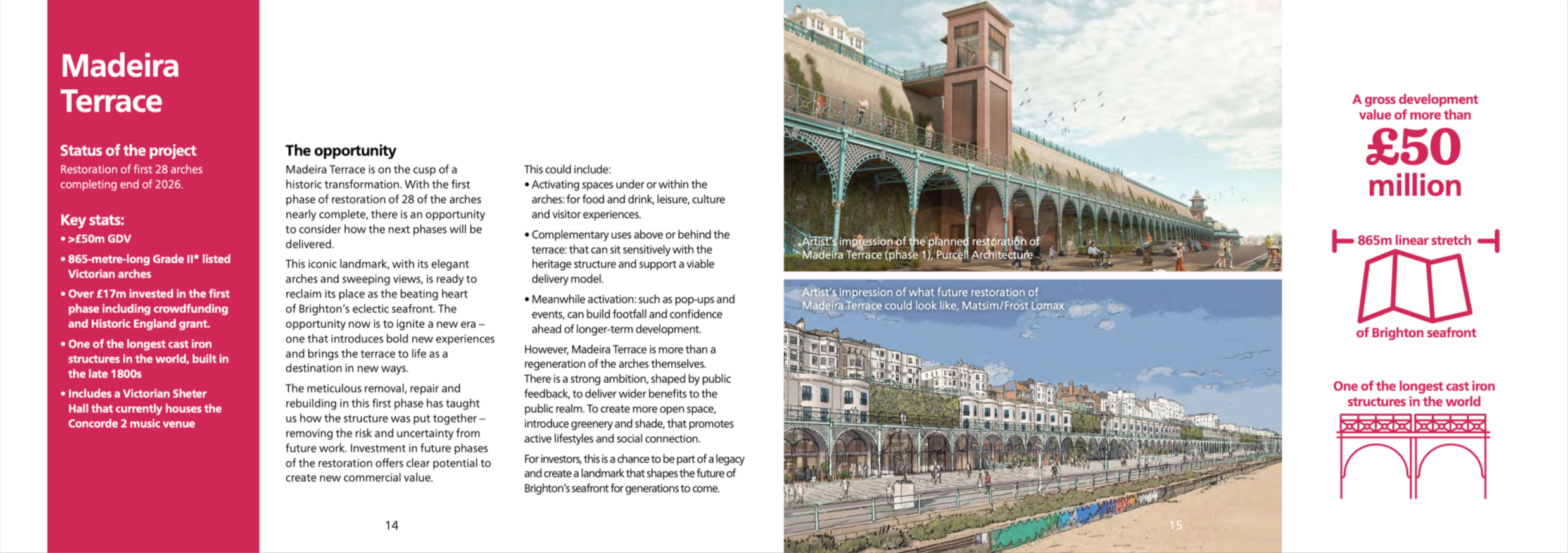
Artist's impression of the planned restoration of Madeira Terrace, one of the longest cast iron structures in the world at 865 metres, stretching along Brighton's eastern seafront. Image: Brighton and Hove City Council
Brighton Centre
The Brighton Centre is owned by Brighton and Hove City Council and is one of the south coast's most iconic venues. It has an existing capacity of 5,500 seats, sells 250,000 tickets per annum for its live entertainment programme, hosts approximately 90 live performances per year and 20 major conventions, and generates around £80 million of economic impact a year for the city.
The prospectus describes the Brighton Centre as a remarkable investment opportunity. The vision is to transform the existing structure by adding an extra floor and creating an improved and easily accessible bridge connection to both the seafront and Churchill Square shopping centre. A strategic brief is currently being prepared to define future use of the site.
A renewed Brighton Centre would not only maintain its legendary status but also deliver enormous economic value to the city, supporting local businesses, generating employment and attracting visitors from across the UK and beyond. By investing in the Brighton Centre, stakeholders become part of a forward-thinking project that safeguards the venue's legacy and boosts Brighton's profile as a vibrant destination. The estimated economic impact of the Brighton Centre is around £80 million per year.
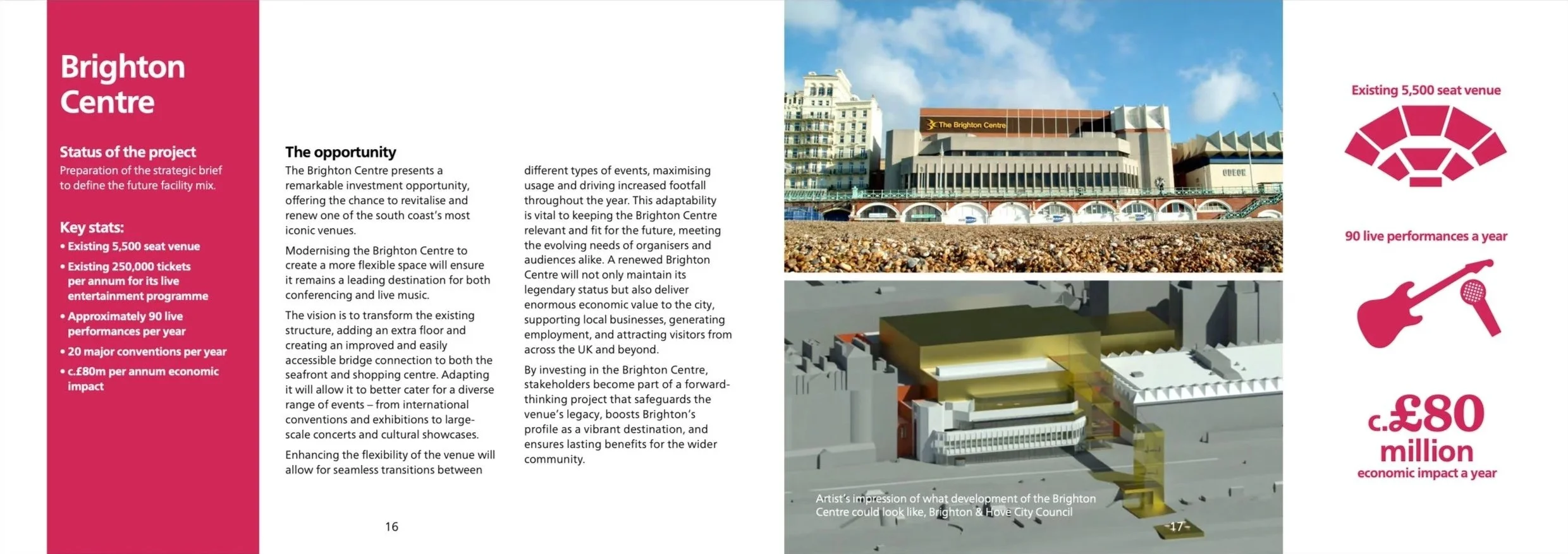
Artist's impression of what development of the Brighton Centre could look like, with an extra floor and bridge connections to both the seafront and Churchill Square shopping centre. Image: Brighton and Hove City Council
Brighton Marina
Brighton Marina has long faced challenges that have held back its true potential. It has historically struggled with a poor public realm, limited and poor quality access from the seafront and the complexities brought about by multiple ownerships. These issues have often made coordinated development difficult, resulting in an underutilised waterfront that does not fully serve the city or its residents.
The City Plan seeks 1,000 new homes at Brighton Marina, 5,000 square metres of new retail development and 3,500 square metres of new leisure and recreation development. Recent improvements along the eastern seafront, most notably the new access road through Black Rock, have set a positive precedent. These enhancements have dramatically improved connectivity and signalled the city's commitment to regenerating its coastline.
Now is the ideal moment to invest in Brighton Marina. Continued investment will help realise the area's promise, building on the momentum of successful projects along the rest of the seafront and ensuring the marina becomes a thriving destination for years to come.
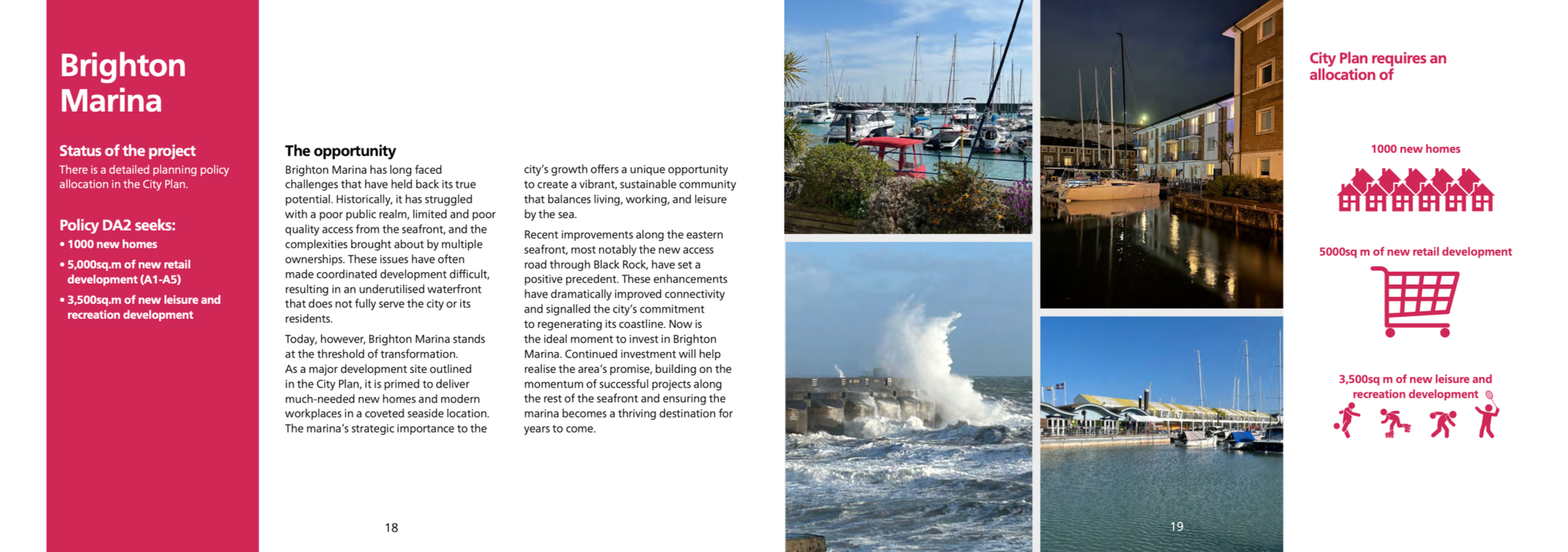
Brighton Marina is earmarked for 1,000 new homes, 5,000 square metres of new retail development and 3,500 square metres of new leisure and recreation development. Image: Brighton and Hove City Council
Pool Valley
Pool Valley represents a significant placemaking opportunity in the heart of the city, close to family attractions and key shopping areas. The existing bus station at Pool Valley is unloved and underused, sitting in a prime location just a short distance from the seafront, close to Brighton Palace Pier, the Sea Life Centre and Brighton Zip as well as key shopping areas. Valley Gardens Phase 3, a public realm project, is close to completion nearby.
There is the potential to transform the existing, unloved bus station into an inviting and vibrant public square, opening up a valuable urban space just a short distance from the seafront. By integrating new public spaces, improved pedestrian access and attractive landscaping, Pool Valley could become a destination that draws people in and fosters greater connectivity.
The redevelopment presents the possibility of being delivered alongside the rebuild of the Royal Albion Hotel, an iconic landmark which could further elevate the appeal of the area. This initiative has the potential to revitalise a tired part of the city, creating an attractive, welcoming hub in a prime location that brings new energy and a sense of pride to the wider community.
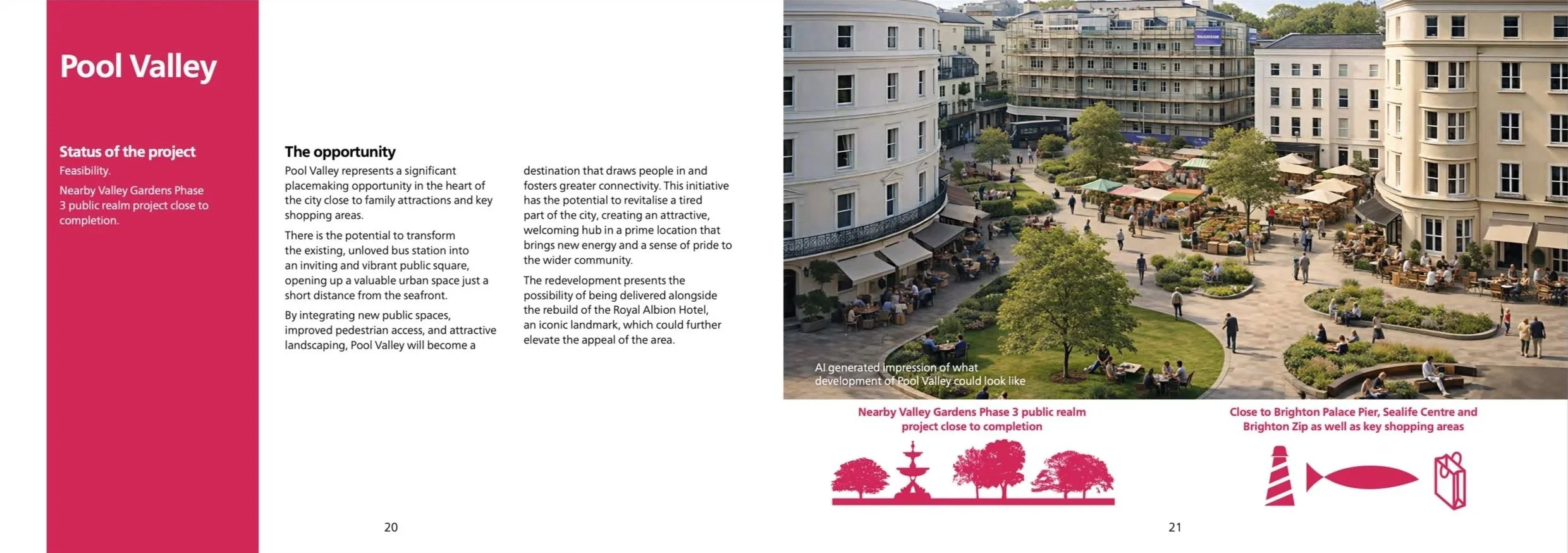
Pool Valley could be transformed from an unloved bus station into a vibrant public square close to Brighton Palace Pier, the Sea Life Centre and key shopping areas. Image: Brighton and Hove City Council
King Alfred
The King Alfred site in Hove is situated adjacent to the development of a new sports and leisure centre for the west of the city. It is widely regarded as the best undeveloped site in Brighton and Hove. It commands stunning views and unrivalled access to the beach and promenade. The site is allocated for a minimum of 400 residential units in the City Plan. Outline master-planning work has been completed for a development of 428 one, two and three-bed residential units. The gross development value of the site is £196 million.
The planned new leisure centre is expected to start on site in November 2026. This state-of-the-art facility for the west of the city will provide fitness, wellness and recreational facilities, underpinning the value of the location and ensuring a vibrant, active community for both families and professionals.
This residential development opportunity represents a truly exceptional prospect for investors seeking to develop an iconic scheme in Hove. Occupying the city's prime seafront location, the site offers ample scope for a range of innovative architectural solutions that combine coastal charm, contemporary convenience and outstanding amenities.
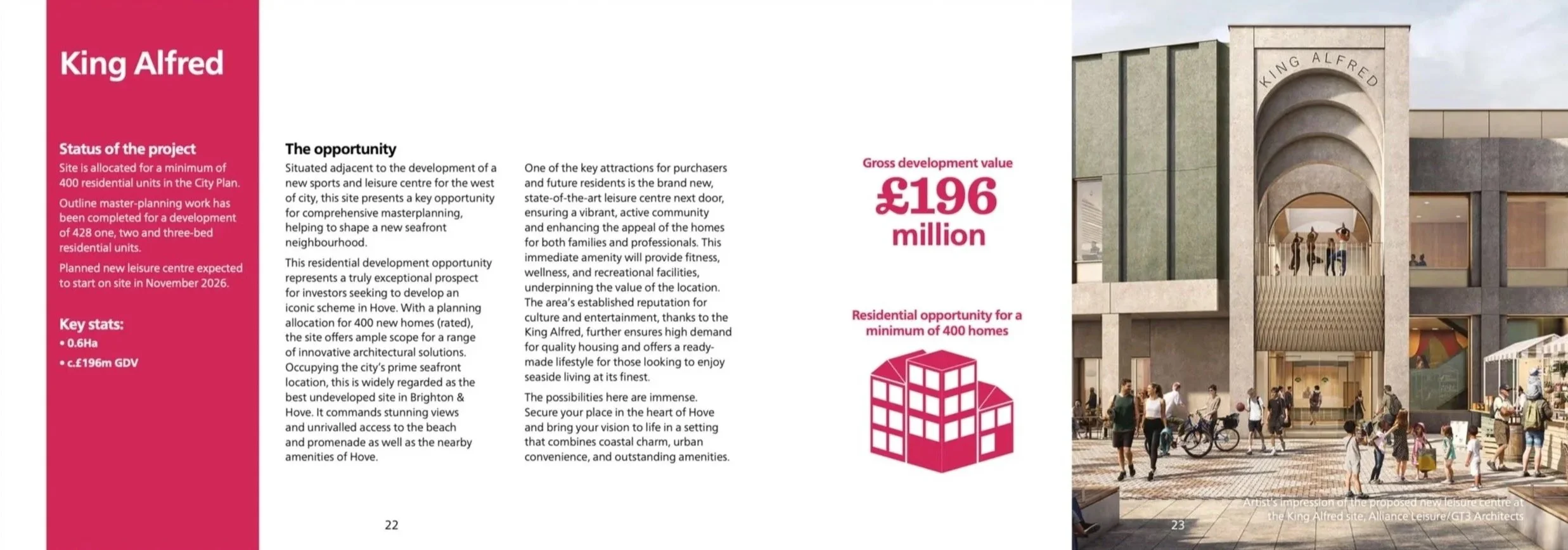
The King Alfred site in Hove has a gross development value of £196 million and is allocated for a minimum of 400 new homes alongside a new leisure centre starting on site in November 2026. Image: Brighton and Hove City Council
Other opportunities for investment
Beyond the six major opportunity sites, the prospectus identifies several other investments already underway or planned for the coming years along the Brighton and Hove seafront.
The Kings Road Arches redevelopment covers two prime stretches of seafront arches from 2026 to 2028, offering the opportunity to create new hospitality spaces fit for all-year-round use. The Kings Road paddling pool and playground is due for redevelopment from 2027, with the potential for a mix of commercial and free-to-use family leisure facilities.
Groyne field work is planned to strengthen coastal flood protection, which will create larger and more stable beaches in West Hove, opening up opportunities for temporary beach installations. The Madeira Terrace Laundry Arch is a historic two-storey property built into the seafront's retaining wall that offers a new hospitality and leisure space.
A new beach sauna will open in Hove Beach Park in 2026. A potential location in Rottingdean has also been identified to add to the existing beach sauna offer across the city.
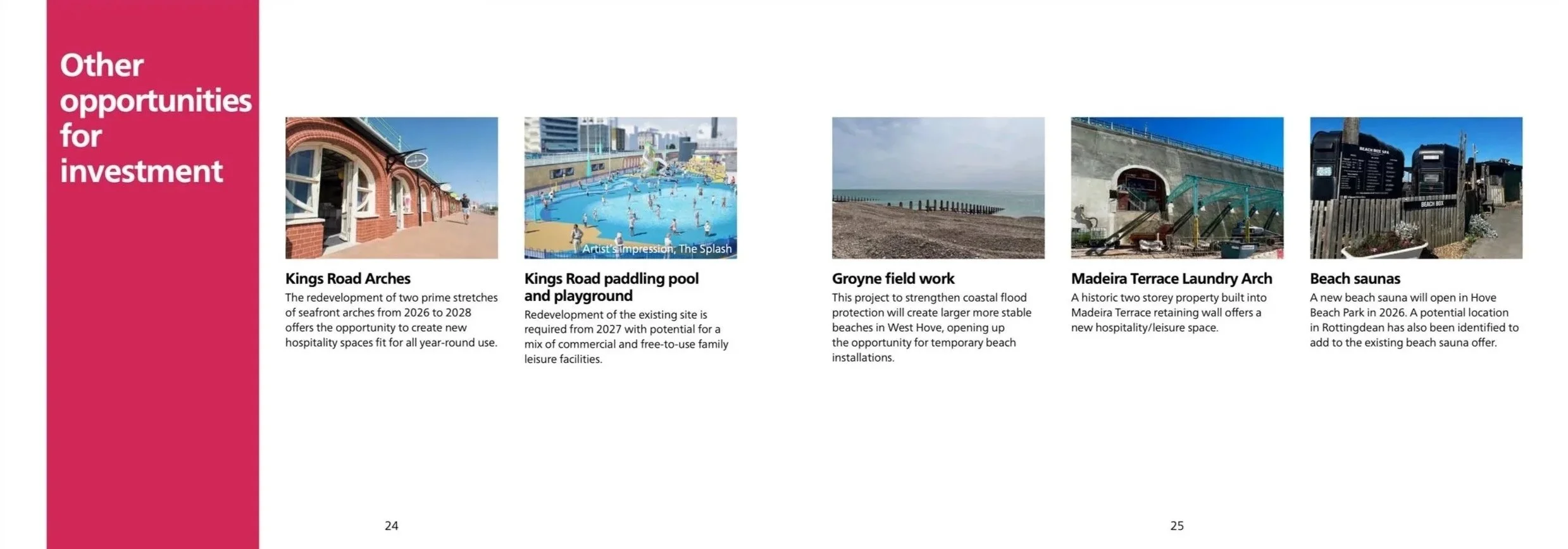
Other investment opportunities along the Brighton and Hove seafront include the Kings Road Arches, the paddling pool and playground, groyne field works, the Madeira Terrace Laundry Arch and a new beach sauna opening in Hove Beach Park in 2026. Image: Brighton and Hove City Council
Connecting the seafront
The prospectus sets out a clear vision for a high-quality, continuous seafront corridor that supports active and sustainable movement, as set out in the recently adopted Brighton and Hove City Transport Plan 2035. This provides a strong framework for linking together Brighton and Hove's coastline in a more coherent, accessible and people-focused way.
The plan covers three sections of the seafront. The western section from Fourth Avenue to the western boundary has an approved active travel scheme on the A259, moving towards construction. Since Hove Beach Park has opened, pedestrian numbers along this section of the corridor have doubled. During summer peaks, over 1,600 cycle movements a day are regularly recorded as well as over 3,000 pedestrian movements. During winter months, over 600 cycle movements a day are regularly recorded as well as over 1,600 pedestrian movements, especially over weekends.
The central section from Fourth Avenue to Palace Pier has a feasibility design underway to extend east-west active travel improvements and create a continuous route. The eastern section along Madeira Drive is a longer-term opportunity linked to future regeneration and development proposals. Looking ahead, a commitment has been made to explore options for a Mass Rapid Transit system along the regional seafront corridor and linking to Brighton Station, enabling integrated journeys.
For more information about the seafront prospectus, visit brighton-hove.gov.uk or email the Seafront Development Board at seafront.board@brighton-hove.gov.uk. For the latest Brighton news, follow ImJustBrighton. For a full guide to Brighton's seafront this summer, read our Brighton Beach Guide 2026.
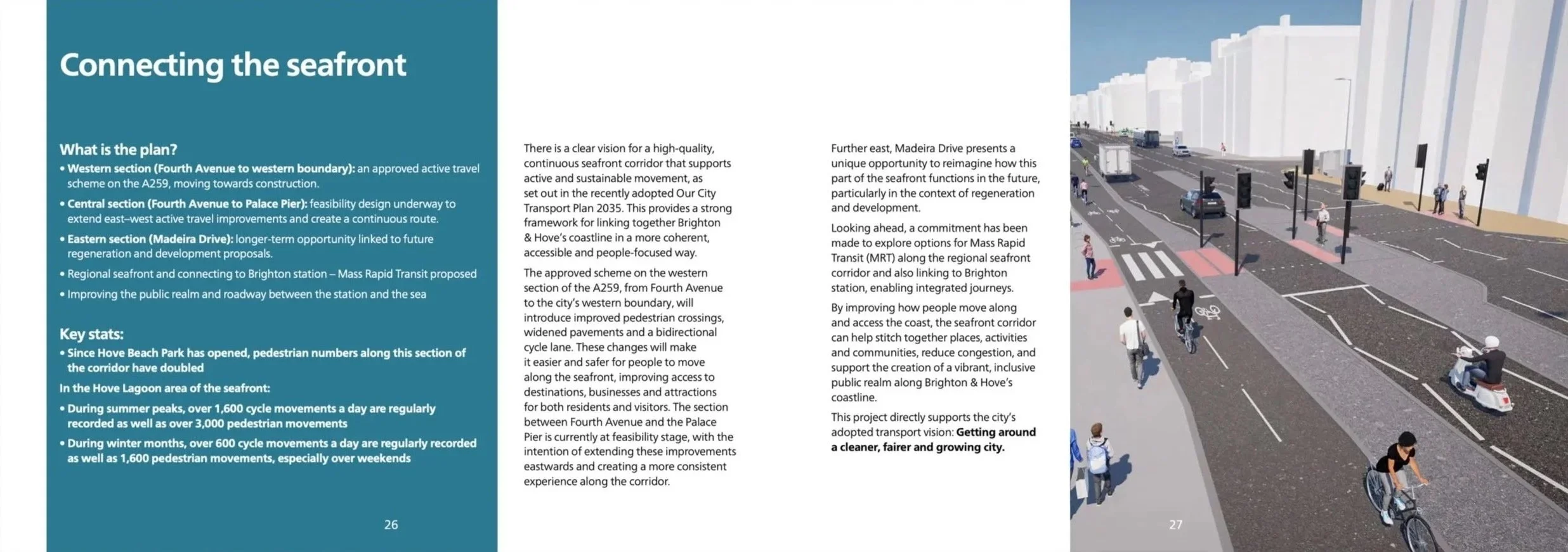
Plans to connect the full 13 kilometre seafront corridor with improved active travel routes, widened pavements and a continuous cycle lane from Hove to Brighton Marina. Image: Brighton and Hove City Council
This article is based on Brighton and Hove City Council's official seafront investment prospectus published on 5 June 2026. All quotes are from official council statements. All images are from the official Brighton and Hove City Council seafront prospectus. Photo: Brighton and Hove City Council.